
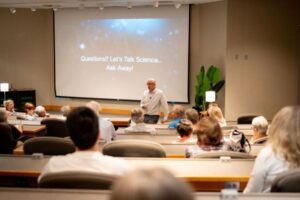
 GREENWOOD, S.C. — The Greenwood Genetic Center (GGC) hosted “Mitochondria in Motion: New Hope for Alzheimer’s Disease and Other Neurodegenerative Disorders,” the latest installment of its Science on Tap community lecture series on Thursday, September 17th.
The free program featured Rich Steet, PhD, GGC’s Director of Research, who shared the science and stories behind GGC’s innovative mitochondrial research.
Steet explained that mitochondria, the powerhouses of the cell, produce the energy that cells need to function. When neurons become energy deficient, they can eventually die, contributing to the symptoms of many neurodegenerative diseases, including Alzheimer’s. GGC researchers are collaborating with MitoSense and the Veteran’s Administration to investigate whether replacing failing mitochondria with healthy mitochondria could offer a new therapeutic approach.
The research builds on the discovery that mitochondria naturally move between cells. GGC scientists are working to understand the mechanisms that allow cells to take up mitochondria and determine how that process could be harnessed for mitochondrial transplantation therapy.
Steet highlighted GGC’s Carroll A. Campbell Jr. Alzheimer’s Initiative, which helped launch GGC’s mitochondrial research. Initial funding from the SC Governor’s Office supported the effort, through which GGC researchers have optimized a process for isolating healthy mitochondria for potential therapeutic use. Studies have demonstrated improvements in behavior in Alzheimer’s disease mouse models following mitochondrial transplantation and are helping to identify mechanisms involved in mitochondrial uptake into cells.
The work is also expanding into other disorders. A clinical trial for ALS is being planned at the U.S. Department of Veterans Affairs hospital in Tampa that will use doses of mitochondria isolated at GGC. Researchers are also using an assay developed at GGC to identify medications and other compounds that may influence mitochondrial uptake, while also exploring applications for rare genetic mitochondrial disorders that impact both children and adults.
The evening concluded with questions from the audience with enthusiastic community interest in learning about innovative research taking place in Greenwood and its potential to advance new approaches to both rare and common genetic and neurodegenerative diseases.