
Finding Purpose from Perspective
For Greenwood Genetic Center intern Riley Crawford, the path to a career in genetics isn’t just academic—it’s personal.
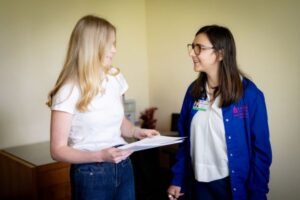
A senior at Lander University, Riley is studying public health with a certificate in genetic studies and preparing for a future in genetic counseling. Her interest in the field grew not only from scientific curiosity, but from lived experience.
Diagnosed in infancy with Leber Congenital Amaurosis Type 1 (LCA1), a rare genetic condition that causes significant vision loss, Riley has spent her life navigating a world not always designed with her in mind. But rather than narrowing her path, that experience has helped define it.
Riley’s vision loss made her first career choice – to be a nurse like her mother – inaccessible. Instead, she found a new direction in genetic counseling—one that still allows her to focus on patient care, advocacy, and education.
Her motivation is rooted in a moment her family never forgot.
When Riley was a baby, her parents noticed something wasn’t quite right. She wasn’t visually tracking objects, and her eyes moved involuntarily—a condition known as nystagmus. After a series of appointments, her mother received a life-changing phone call: her child had LCA and would be blind.
“That was all they were told,” Riley said. “Just the diagnosis.”
With her mother’s medical background, Riley’s family was able to find specialized care and support, but she knows that many others are not as fortunate.
“A lot of families get a diagnosis like that and don’t know what to do next,” she said. “Genetic counseling, to me, is about being there in that moment—explaining what’s happening but also helping people find resources and support. Not just giving them a name.”
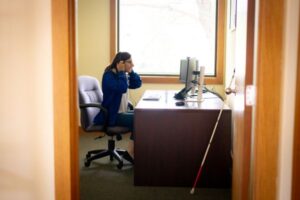
During her semester-long internship at GGC, Riley has gained hands-on experience supporting the clinical team – processing referrals, reviewing patient information and routeing cases to the appropriate clinic.
It’s detail-oriented work—and work that relies on accessible technology. Riley uses screen-reading software called JAWS (Job Access With Speech), which reads digital content aloud and allows her to navigate systems efficiently.
Beyond the technical experience, Riley says one of the most valuable parts of her internship has been simply being immersed in the environment—observing how genetic professionals communicate, collaborate, and support patients. She also had the opportunity to connect with GGC researcher, Dr. Gavin Arno, who has expertise in inherited retinal conditions—an area closely connected to her own diagnosis.
Equally meaningful has been Riley’s experience with the culture at GGC.
“Usually there’s an awkward conversation about disability,” she said. “There wasn’t one here, which was really refreshing. They just accepted it as part of me—but not all of me.”
“People often see the disability first,” Riley said. “Here at GGC, they see me first.”
After graduation, Riley plans to continue building her skills through a specialized training program for individuals who are blind, before pursuing a role as a genetic assistant—maybe even returning to GGC in the future.
Her long-term goal remains clear: to support individuals and families navigating the same uncertainty that her family once experienced.
“The biggest thing about both disability and genetics is that they’re always evolving,” she said. “It’s constant learning, constant adapting. You never stop growing.”
For Riley, that mindset isn’t just a perspective—it’s a calling.
Read more GGC stories in the Summer 2026 issue of Helix Highlights!