
Innovation and persistence bring hope in rare disease diagnosis
When families arrive at GGC after years of unanswered questions, they are often carrying the weight of an exhausting journey. They have seen specialists, undergone countless tests, and still hear the same difficult answer: “We don’t know.”
For many living with rare genetic conditions this search for answers can feel endless.
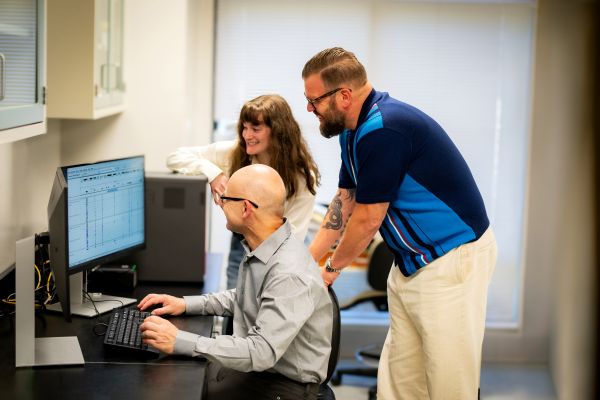
That is where Dr. Gavin Arno and his team step in.
Dr. Arno, Associate Director of Research at GGC, is a leading scientist in ophthalmic genetics and inherited retinal disorders. He joined GGC in 2024 from London at Moorfields Eye Hospital, the UCL Institute of Ophthalmology, and Great Ormond Street Hospital for Children, where his laboratory spent more than a decade advancing the understanding of genetic eye disease.
Over the course of his career, Dr. Arno has helped shape the field of inherited retinal disease (IRD) genetic research. He has pioneered the use of whole genome sequencing to uncover causes of retinal disorders and has contributed to several novel gene discovery projects that identified new genetic causes of vision loss.
At GGC, Dr. Arno continues this mission by working across divisions to better understand how rare genetic changes lead to disease. He also leads an NIH-funded COBRE research project in collaboration with the Clemson University Institute for Human Genetics and plays a key role in the Center’s Genomic Discovery Program—efforts aimed at pushing the boundaries of what can be found in the genome and how those discoveries translate to patient care.
Working alongside him are Madeline Bellanger, PhD, a bioinformatics postdoctoral associate, and staff scientist, Bruno Poplawski, PhD, MB(ASCP), MASCP, and together, the team tackles some of the most complex unsolved genetic cases at GGC.
While traditional genetic testing can identify many known causes of disease, some answers remain hidden in difficult-to-read regions of the genome. Dr. Arno’s team uses advanced technologies, including long-read sequencing from Oxford Nanopore Technologies, to uncover structural changes and hard-to-detect variants that may be responsible for disease.
They also focus on “variants of uncertain significance”—genetic findings that cannot immediately be labeled as damaging or benign. The team carefully reanalyzes the data, applies additional studies when possible, and searches for evidence that can turn uncertainty into clarity.
Dr. Arno’s team never loses sight of the fact that behind every genome is a family waiting for answers, many of whom have spent years navigating uncertainty about a child’s vision loss or a progressive eye condition. Even when a cure is not yet available, a precise diagnosis can bring clarity, access to accurate genetic counseling, and eligibility for clinical trials.
Each case is reviewed with care because small details in DNA can have life-changing meaning.
Dr. Arno’s impact extends far beyond GGC. He continues to collaborate internationally, including contributions to large-scale initiatives such as the UK 100,000 Genomes Project, leadership roles in global variant curation efforts for retinal disease, and advisory and academic appointments with institutions including University College London and research partners in Japan. These collaborations help ensure that discoveries made in one part of the world can benefit patients everywhere.
Through innovation in genomic science and a commitment to families facing rare disease, Dr. Arno and his team are helping transform uncertainty into answers—and, step by step, turning unresolved questions into hope.
Read more GGC stories in the Summer 2026 issue of Helix Highlights!