
Compassion Fuels Dr. Francyne Kubaski’s Mission to Advance Newborn Screening
At GGC, science and compassion go hand in hand—and few people embody that more than Francyne Kubaski, PhD, a staff scientist in GGC’s Biochemical Genetics Laboratory, whose work is transforming the early diagnosis and treatment of rare genetic disorders.
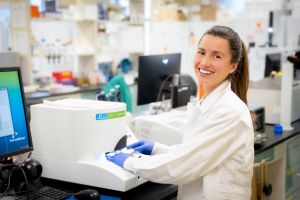
Dr. Kubaski’s journey into newborn screening (NBS) began in 2013, during her doctoral studies at the University of Delaware. Her graduate research focused on developing new ways to detect mucopolysaccharidoses (MPS)—a group of rare, but treatable, metabolic diseases—using a powerful technology known as tandem mass spectrometry. “Back then, MPS screening was just a pilot idea,” she recalls. “Now, two types of MPS (I and II) are part of the national screening panel. It’s amazing to see how far we’ve come.”
At GGC, Dr. Kubaski continues to innovate by developing new methods to improve how newborns are screened, diagnosed, and monitored for treatment. Her work focuses on identifying biochemical markers, or “biomarkers,” that can provide an early diagnosis, monitor treatment success, and support novel treatments and clinical trials. One example is psychosine, a molecule that plays a critical role in screening for Krabbe disease—a rare but fatal neurological disorder if untreated. “Our lab validated psychosine testing,” she explains. “It’s now used in newborn screening across the country and helps us both diagnose patients and track treatment progress.”
Kubaski and her colleagues have also validated tests for metachromatic leukodystrophy (MLD), and alpha-mannosidosis with projects in the pipeline for Fabry disease, Gaucher disease, and several forms of MPS, all using tiny drops of blood from a baby’s heel. These methods not only help identify disease early but also guide clinical trials and therapeutic monitoring, paving the way for new treatments and FDA approvals. “It takes a village,” she emphasizes, acknowledging her GGC colleagues who collaborate closely to validate each new test.
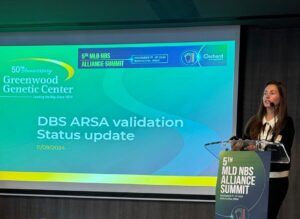
Widely published and the recipient of numerous young investigator awards, Dr. Kubaski’s expertise has taken her around the world to share her work—from the WORLD Symposium in San Diego to newborn screening summits in Austria, Spain, and her native Brazil. As a member of both the Global and US MLD Alliances, she contributes to international efforts to expand newborn screening and improve access to life-saving diagnostics. Yet, she says, meeting families is what really fuels her passion.
“Listening to parents share their stories grounds and motivates me,” she says. “I’ve met families who lost one child to a genetic disease, only to have another child saved because the science had finally caught up.” She recalls meeting the mother of two girls with MLD—one tragically too late for treatment, the younger thriving thanks to early gene therapy. “Seeing that little girl run and play on stage reminded me exactly why we do this work,” she says. “No family should have to lose one child to save another.”
For Dr. Kubaski, newborn screening is not just a scientific pursuit—it’s a passion project. Each test she develops brings the world closer to ensuring that every baby, regardless of where they’re born, has the chance for a healthy start. “A few drops of blood can change a family’s entire future,” she says. “That’s the miracle of science—and it’s what drives me every single day.”