
 (August 20,2025) – The Greenwood Genetic Center (GGC) is proud to announce its central role in a newly awarded $5.4 million Program Project Grant (P01) from the National Institute of Neurological Disorders and Stroke (NINDS), part of the National Institutes of Health (NIH). The five-year initiative, titled “Investigation of Neural Pathogenic Mechanisms Associated with Congenital Disorders of Glycosylation (CDG),” supports five leading research institutions in a collaborative effort to understand why patients with CDG so commonly experience neurological symptoms such as developmental delays and seizures.
CDGs are a large group of rare inherited diseases affecting the process of glycosylation, the addition of sugar building blocks to proteins. In addition to neurological symptoms, patients with a CDG may experience other health problems such as growth delay, poor muscle tone, skeletal issues, and eye anomalies.
The project is co-led by Dr. Richard Steet, Director of Research at GGC, and Dr. Eva Morava-Kozicz of the Icahn School of Medicine at Mount Sinai, and brings together a distinguished team of investigators leveraging expertise in clinical care, model organisms, and cutting-edge technologies.
GGC is spearheading one of the three integrated research projects under this grant. Dr. Heather Flanagan-Steet, Associate Director of Research at GGC, will lead Research Project 1, which utilizes zebrafish models of two types of CGD, PMM2-CDG and PIGA-CDG. This project will examine how glycosylation defects impact different cell types in the developing zebrafish brain, offering critical insight into how neurological symptoms arise in patients with CDG.
“Zebrafish provide a powerful and highly visual way for studying developmental processes in real time,” said Dr. Flanagan-Steet. “With this support from the NIH, we can now delve deeper into why these cellular changes occur the brain by CDG. This effort is enhanced by working closely with our collaborators who will be exploring related questions in other model systems.”
Dr. Richard Steet added, “This grant is a milestone for CDG research and a testament to the importance of collaborative science. The Greenwood Genetic Center is honored to be a leading partner in this initiative and to help accelerate discoveries that could ultimately lead to effective therapies for patients.”
The NIH-funded program brings together a team of investigators across five renowned institutions:
- Greenwood Genetic Center
- Icahn School of Medicine at Mount Sinai
- University of Utah Health
- Mayo Clinic
- Emory University
In addition to GGC’s zebrafish research, other model systems—including fruit flies (Drosophila) and lab-grown brain organoids (“mini-brains”)—will be used to study neurological defects in CDG. These different models will allow the team to explore disease mechanisms from multiple angles and share findings, a hallmark of the P01 grant structure.
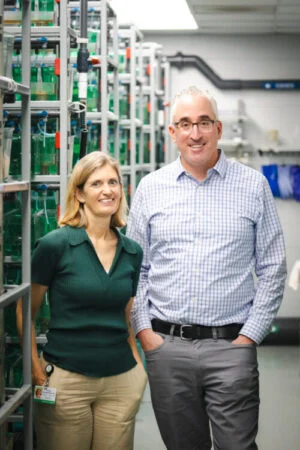
Photo: Drs. Heather Flanagan-Steet and Rich Steet in GGC’s Allin Aquaculture Facility