
Unlocking Answers in the Genome: Why Precision Medicine Matters
GGC’s Precision Medicine Initiative consists of four distinct, yet cohesive pillars that are known as the four A’s – Access, Analysis, Answers, and Action. In this series we will share more details about each of these four pillars. Here’s more on ANALYSIS…
For families facing the uncertainty of a rare genetic condition, answers can take years—or may never come at all. At the Greenwood Genetic Center (GGC), nearly half of patients every year still leave without a diagnosis, even after undergoing the most advanced testing available today. But the story doesn’t end there.
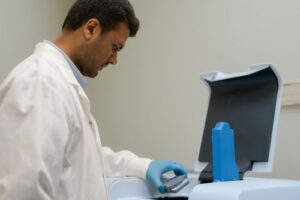 Thanks to rapid advances in genomics and data science, a new era of precision medicine is taking shape—one that aims not just to treat, but to understand the exact cause of each patient’s condition. With a focus on ANALYSIS, GGC’s Innovation Initiative is at the heart of this transformation. This initiative brings together cutting-edge technologies and decades of clinical expertise to explore new tools that can diagnose even the rarest and most complex genetic conditions.
Let’s take a look behind the scenes at how GGC is turning unknowns into answers through groundbreaking efforts in genomic data analysis, advanced testing techniques, and novel diagnostic platforms.
Data at the Core: Building a Genomic Warehouse of Knowledge
At the center of GGC’s diagnostic power is something invisible but essential: data.
Over five decades, GGC has accumulated a vast trove of genetic and clinical data from patients with a wide variety of conditions. But until recently, unlocking the full potential of that data was a challenge. With the help of Amazon Web Services (AWS), GGC has now developed a cloud-based genomic data warehouse—a secure and scalable system to store, organize, and analyze genetic data more effectively.
And with the support of the Guardian Research Network, we have recently completed the scanning of 3.2 million pages of paper charts to be integrated into the data warehouse.
The warehouse provides instant access to data that used to be challenging to find improving the ability to access medical records. The ultimate goals of this project are to improve diagnoses by allowing clinicians to identify patterns and similarities that might point to a rare genetic condition and eventually utilize machine learning to find hidden connections in datasets that would be missed using traditional data analysis alone.
This kind of data integration is the backbone of precision medicine. It allows researchers to not just analyze a patient’s DNA, but also compare it to others, accelerating insights that can lead to a diagnosis.
The Innovation Center: Where Cutting-Edge Meets Compassion
Sometimes, even the most comprehensive genetic tests can’t find a clear answer. That’s where GGC’s Innovation Center steps in – bringing the most promising new technologies into clinical care.
Here are four of the exciting and innovative tools that GGC is working with today:
EpiSign: Reading the Epigenetic Signature
GGC is the only lab in the U.S. offering EpiSign, an innovative and unique test that doesn’t look at your DNA sequence—but how your genes are expressed or turned on and off.
Many rare disorders leave behind unique epigenetic signatures—chemical changes that alter gene expression. EpiSign uses machine learning to compare a patient’s signature to a growing EpiSign Knowledge Database, which currently includes data for over 90 genetic conditions.
While treatments for many of these conditions are still in development, getting a diagnosis through EpiSign can help confirm a previously uncertain diagnosis, guide medical management, and open doors to supportive resources for families.
“EpiSign provides an additional high-yield diagnostic tool for clinicians… providing better medical management for patients and hope for their families.” – Dr. Matthew Tedder, GGC Staff Scientist
Optical Genome Mapping: Seeing the Big Picture
Imagine trying to solve a puzzle, but your pieces are blurry or incomplete. That’s often the challenge in diagnosing structural changes in the genome—such as missing or extra pieces of DNA.
Now, with Optical Genome Mapping (OGM) using Bionano’s Saphyr system, GGC can see the genome with 1000x the resolution of traditional chromosome analysis. OGM effectively replaces three standard tests (karyotyping, microarray, and FISH) with a single, powerful assay.
Already, this technology has revealed diagnoses in complex prenatal cases and identified new genetic causes for birth defects of the brain and spine, providing answers where standard testing had come up short.
“We can identify genomic changes that we would never have been able to detect with any other test.” – Barb DuPont, PhD, Senior Director, GGC Cytogenetics Lab
Long-Read Sequencing: Zooming in on Genetic Mysteries
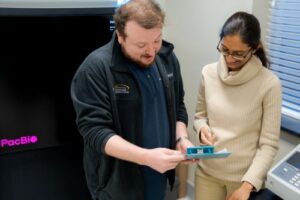 Current genome sequencing uses short-read sequencing, which breaks DNA into small segments for analysis. It’s fast and efficient—but can sometimes miss important details, especially in complex regions of the genome.
Now, thanks to funding from the Fullerton Foundation, GGC has added the PacBio Revio system, a long-read sequencer that reads much longer stretches of DNA at once. This allows scientists to detect mutations that were previously hidden, offering new hope to families who have been searching for answers for years.
“Long-read sequencing is like using a magnifying glass on the parts of the genome that have been historically too hard to read.” – Carder Jones, GGC Bioinformatics Analyst
RNA Sequencing: Listening to How Genes Are Used
RNA is a molecule in the cell that acts as a messenger to transfer genetic information from DNA to create proteins. It is possible to have a gene that appears typical in its DNA code, but if there’s an issue with how the RNA is created and functioning, the gene may not be expressed correctly resulting in a genetic disorder.
GGC is currently using RNA sequencing on an investigational basis which allows GGC scientists to see how genes are actually being expressed which provides another layer of diagnostic insight.
RNA sequencing can be applied in a targeted way to determine whether a specific genetic variant is clinically significant or to find ‘second hits’ in a gene where two variants are necessary for diagnosis, but traditional testing has only identified one.
Because not all genes are expressed in every type of tissue, RNA sequencing can also be used more broadly to look for unknown outliers in any gene that is active in a particular tissue type, such as blood or skin cells.
By combining RNA sequencing with DNA-based tests, GGC can spot cases where a gene looks OK on paper but isn’t functioning properly—adding yet another tool in the diagnostic toolbox.
“RNA studies- targeted and global, give us a powerful way to move from genetic ‘maybes’ to clearer answers for patients, by showing how variants actually change gene messages in the cell.” -Sneha Mokashi, PhD, GGC Staff Scientist
Looking Ahead: A Future Full of Possibilities
The Greenwood Genetic Center’s Precision Medicine Initiative is more than a research effort—it’s a promise to families that science will keep moving forward in the search for answers.
From data warehouses and machine learning to long-read sequencing and epigenetic testing, GGC is combining technology, expertise, and compassion to revolutionize how rare genetic conditions are diagnosed.
And while we may not yet have all the answers, every new tool brings us one step closer to the day when every patient has a clear diagnosis—and a path forward.
Want to support innovation at GGC?
Your investment in the Innovation Initiative helps bring life-changing technologies to patients in need. Learn more at ggc.org/foundation.