
Optical Genome Mapping – Complete
Optical Genome Mapping – Complete
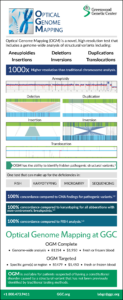
Optical Genome Mapping (OGM) is a next-generation cytogenomic technique that can detect several classes of structural variants (SVs) at a higher resolution compared to conventional cytogenetic methods. OGM is based on imaging ultra-long single DNA molecules (>150 kb), fluorescently labelled at specific sites throughout the genome. The images are used to generate de novo genome assembly, and the labelling pattern is compared to a reference genome to detect different classes of SVs, which includes triploidy, aneuploidies, deletions, duplications, balanced and unbalanced events (insertions, inversions and translocations).
Clinical Information
OGM is intended to identify underlying genetic causes of intellectual or developmental disabilities, birth defects, or other unexplained medical conditions. This test may be considered for patients suspected of having structural variants that have not been previously identified by traditional testing methods such as chromosome analysis, FISH, microarray, PCR, short-read next-generation sequencing or Southern blot. OGM can be ordered as a targeted test for a specific region/gene(s) of interest or as a genome-wide screen.
Technical Information
OGM detects several classes of structural variants (SVs), including triploidy, aneuploidies, copy number variants (deletions and duplications), balanced and unbalanced events (insertions, inversions and translocations). OGM will not detect Robertsonian translocations, balanced translocations which have breakpoints in the centromere, or regions of homozygosity (<25 Mb). OGM does not detect single nucleotide variants (SNVs) or other small SVs with potential functional impacts.
Please note that OGM Complete reporting is phenotype-driven according to the specific findings listed on the requisition form. If specific structural variants are of interest, please notify the laboratory in advance.
Specimen Requirements
The accepted sample type is 3-4 ml of fresh or frozen peripheral blood collected in an EDTA (purple top) tube. Ultra-high molecular weight DNA is required for OGM analysis and can only be extracted if specimen and transport requirements are met. Blood kits are available by request.
Transport Instructions
Ship the blood sample overnight in an insulated container with cold packs no colder than 4°C (refrigerated temperature). Incidental freezing and thawing due to cold packs cooler than 4°C may diminish DNA quality. Frozen blood should be shipped on dry ice.
Associated Tests
Connect With Our Experts
Call 1-800-473-9411 to speak with our team of laboratory genetic counselors for questions or additional information.
Robin Fletcher, MS, CGC
Falecia Thomas, MS, CGC
Alex Finley, MS, CGC