
Then and Now: Education
As we celebrate GGC’s 50th anniversary, we will publish monthly ‘Then & Now’ blog posts throughout 2024.
Follow along with us as we reminisce!
Choosing a career is one of the most important decisions you will make, but what happens after that choice is equally important.
Especially in a field like genetics where advances happen quickly, continuing education is critical to both your career and for the well-being of patients. At GGC, the formula is very simple: learning from the best in the field + sharing your knowledge with others = more patients being helped. It was this emphasis on the importance of education by our cofounders, Dr. Roger Stevenson and Dr. Hal Taylor, that has led to GGC’s successful and impactful educational programs.
While the Division of Education wasn’t formally established until 1993, the Center’s commitment to education and access to educational programs and materials was one of GGC’s founding principles. All faculty and staff were committed to education with a formal leader, Dr. Richard Schroer, being named in the 1980s.
In the early years, GGC’s education initiatives included establishing a library, launching “Genetics for the Practicing Physician,” organizing the South Carolina Genetics Conclave, and starting postdoctoral training programs.
- The GGC library was established when the Center moved from Spring Street to Gregor Mendel Circle. The library housed medical journals, computers, and a quiet space to read. The library is now located in the JC Self Research Institute, and while we all now have online access to resources in our offices or on our phones, the library remains a valuable resource for all at GGC.
- “Genetics for the Practicing Physician” was GGC’s first continuing education program in 1975, it attracted sixty physicians to hear lectures from geneticists nationwide. A weekly case conference where each clinic location presents cases has now taken its place.
- The South Carolina Genetics Conclave, started in 1979, was a bimonthly event where genetics professionals across the state could learn from colleagues, discuss clinical cases as well as new initiatives in the field. Today, the South Carolina Genetics Conclave now occurs on an annual basis, and thanks to technology, learning from the best across the country is an easier feat.
- The postdoctoral training programs started in 1978 to further educate those pursuing a career in genetics. This filled a training gap until accredited fellowships and board exams were established. The postdoctoral training programs are still going strong today and fellowships are accredited by the American Board of Medical Genetics and Genomics.
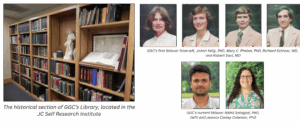
Fast forward to today. The Division of Education has been established for some time now, and it has been under the direction of Leta Tribble, PhD, since 2000. How Dr. Tribble started at GGC and her first meeting with Dr. Stevenson is a story for another day (it’s fascinating), but how she has expanded the education division’s impact is equally fascinating. Dr. Tribble still oversees the library, South Carolina Genetics Conclave, and the postdoctoral training programs, but you can also add Project ECHO and state-wide outreach education programs to her list.
- Project ECHO (Extension for Community Healthcare Outcomes) utilizes technology to connect healthcare providers with experts in various fields to expand access to specialized medical knowledge, ultimately improving patient care.
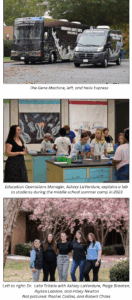 State-wide outreach encompasses genetics-related educational activities across South Carolina, including teacher courses, field trips to GGC, and summer camps. Are you tired yet? Thankfully, Dr. Tribble was able to expand her team of one to a team of seven – a librarian, a bus driver, and four instructors.
- The summer teacher courses began in 1994 with the purpose of broadening and enhancing teachers’ knowledge to make them feel more confident in teaching genetics. Teachers complete didactic lessons online before arriving to GGC for a lab workshop that they can easily replicate in their classrooms. Dr. Tribble actually took this course in 1995 when she was teaching high school science.
- In 2010, the Gene Machine Mobile Science Lab Program began, featuring a 41-foot coach customized as a mobile science laboratory that accommodates up to 24 students. The Helix Express, added in 2017, is a cargo van that transports lab equipment. Together, the Gene Machine, Helix Express, and GGC’s instructors travel to middle and high schools across the state, teaching students about genetic traits and disorders, lab techniques for making a genetics diagnosis, the ethical implications of testing, and careers in the life sciences.
- Teachers can also bring their students to GGC’s Genetics Education Center on field trips. Instead of being on the Gene Machine, the students are able to learn in the former biochemical lab. What makes this experience so unique compared to the Gene Machine is that science comes to life as students are able to observe laboratory professionals on the job.
- Middle and high school students can also attend GGC’s summer genetics camps. This year’s middle school camp theme is pop culture, featuring an interactive Clue game where students collect evidence, process DNA samples, and solve the mystery of Who? Where? With What? High school students will explore ecological genetics, studying topics such as a contagious cancerous tumor in Tasmanian devils, potentially extinct lemurs in Madagascar, and the effects of genetic mutations on worms’ reactions to certain chemicals. Fascinating topics!
While the techniques and opportunities available through GGC’s educational efforts has changed drastically over the last 50 years, what has remained the same is our commitment to engaging and supporting our future geneticists. The impact on students is clear, as many who participated in a lab on the Gene Machine or attended a summer camp are now applying for internships or even jobs at GGC after graduation. While looking back at these changes, you can’t help but wonder, what is left for them to do?
But I have a feeling their job isn’t done, yet.
Post by Caroline Pinson