
As we celebrate GGC’s 50th anniversary, we will publish monthly ‘Then & Now’ blog posts throughout 2024.
Follow along with us as we reminisce!
Rare diseases are defined as those that affect fewer than 200,000 people in the US. But with more than 6,000 known rare diseases, they actually aren’t so rare. Over 300 million people world-wide are living a with a rare disease, not to mention those who are currently undiagnosed.
Because 80% of rare diseases are genetic, this is an area of expertise and passion for GGC. You could say that rare diseases are in GGC’s DNA (pun intended). From the discovery of new conditions, research to better understand how they happen, and clinical trials to explore new treatments, GGC is with patients and families impacted by rare diseases every step of the way.
This month we’re highlighting three rare diseases that have had a special connection to GGC over the years.
Phelan-McDermid syndrome
If you’ve been following along as we have highlighted significant achievements of the past 50 years, the ‘Phelan’ name may sound familiar to you – Katy Phelan, PhD, was GGC’s first cytogenetics 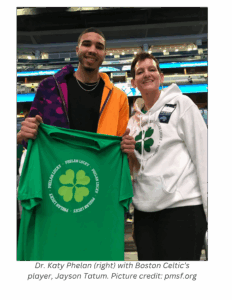 fellow and the first director in the cytogenetics lab.
Phelan-McDermid syndrome was first described in 1988, when Dr. Phelan, along with GGC clinicians Dr. Curtis Rogers, and Dr. Bob Saul presented a poster at the American Society of Human Genetics meeting, describing a patient with developmental delay who was missing genetic material from the long arm of chromosome 22. This caught the attention of Dr. Heather McDermid from Canada who also had patients fitting the description. In 1992, this team published the first description of this disorder which was later named for Drs. Phelan and McDermid by parents who were creating a foundation to improve awareness and support research efforts. Dr. Phelan played a huge role in bringing these families together and remains very active in their efforts.
At the time, chromosome analysis was the only methodology available for Dr. Phelan to identify the deletion on chromosome 22 (remember when we talked about chromosome analysis back in January?). But this methodology had its limitations – it was not able to identify smaller deletions. By the mid-2000s, the cytogenetics lab began using chromosome microarray analysis, a more advanced testing methodology to detect smaller deletions, making it easier to diagnose this complex disorder.
PMS has clinical and genetic variability. Common features of patients with PMS include intellectual disability, low muscle tone, seizures, behavioral issues, autism, and other neurological symptoms. And then you have the genetics behind PMS. Even though PMS was identified in a patient with a deletion, some patients may have PMS caused by sequence change in the gene, SHANK3. Complex, right?
Fragile X syndrome
Fragile X syndrome (FXS) is one of those rare disease that might be a little more well-known as it is the most common cause of inherited intellectual disability. FXS is caused by a change in the FMR1 gene located on the X chromosome. The FMR1 protein is crucial for brain development. Males with an FMR1 variant are typically more severely affected because they only have one X chromosome, whereas females, with two X chromosomes, may be less affected due to having a second, functional copy of the FMR1 gene.

Initially, the only way to identify FXS was by looking at the chromosomes and visualizing a narrow ‘fragile site” on the X chromosome under the microscope. But this type of testing was not perfect, and many cases were missed, especially in females. In 1991, FMR1 was identified as the gene responsible for FXS and more accurate testing became available via repeat analysis years later. Remember that genes have a sequence of letters (A, C, G, T). FMR1 has a sequence of repetitive CGGs (CGG-CGG-CGG…) and Fragile X is caused when a patient has more than 200 CGGs in a row.
So why is FXS special to GGC? GGC’s research division started working on FXS in the mid-1980s, well before FMR1 was identified as the causative gene. Then GGC’s diagnostic lab was the first lab to offer repeat analysis testing for FXS. The repeat analysis technique was adapted by GGC’s former Director of Research, Dr. Charles Schwartz. Sidebar: GGC’s Research Division has been involved in the identification of nearly 1/3 of the genes that cause intellectual disability on the X chromosome!
And we continue that work today – our clinical division not only sees patients with FXS, but is the site of two separate clinical trials studying the efficacy of two medications that help the symptoms of FXS. And then there is FORWARD-MARCH (Fragile X Online Registry With Accessible Research Database Multiple Assessments for Research Characterization), a natural history study to further understand FXS and to connect families to current projects.
Rett syndrome
Rett syndrome is a rare, neurologic disorder that most often affects females. After 6 and 18 months of typical development, individuals with Rett syndrome begin to lose skills and affects the individual’s ability to eat, walk, sleep, speak, and breathe easily. Rett syndrome is caused by mutations in the MECP2 gene, located on the X chromosome, and is one of the most common causes of intellectual disability in females.
GGC has been actively involved in the clinical care and diagnosis of those with Rett syndrome for decades, and GGC’s President and CEO, Dr. Steve Skinner is known as one of the leading experts on this rare disease. 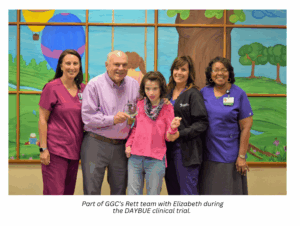
GGC’s clinic has been home to several studies including an NIH-sponsored Natural History Study, which tracks the progression of the disease. And the diagnostic lab was one of the first labs to offer testing for Rett syndrome. It also served as the biorepository for samples collected during the Natural History Study.
Perhaps GGC’s most exciting contribution to Rett syndrome has been the clinic’s role as a clinical trial site for DAYBUE, the first and only FDA-approved drug to treat the symptoms of Rett syndrome. For our ongoing efforts, the International Rett Syndrome Foundation has named GGC a Rett Syndrome Center of Excellence.
GGC has a long and proud history of supporting families and advancing research for rare diseases, but the challenges faced by families with a rare disease continue. The diagnostic odyssey can take years. It takes persistence; persistence from the patients, families, providers, lab personnel, and researchers to get to an answer. It takes collaboration, like that of Dr. Phelan and Dr. McDermid to study, experiment, and publish their findings. It takes compassion and dedication, like that of GGC’s Rett Team, to invest the effort and work to run a successful clinical trial.
Yes, rare diseases like Phelan-McDermid, Fragile X, and Rett syndrome are our niche. We are driven by intellectual curiosity, of course, but from what I have seen in my years at GGC, I honestly believe it is the compassionate care for patients’ and their families that is the driving force.