
Then and Now: Administration
As we celebrate GGC’s 50th anniversary, we will publish monthly ‘Then & Now’ blog posts throughout 2024.
Follow along with us as we reminisce!
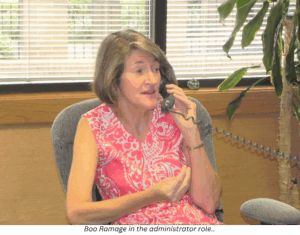 Managing a business is never easy. But when you add insurance to the equation, it becomes a real doozy. When GGC cofounders, Dr. Roger Stevenson & Dr. Hal Taylor hired Boo Ramage as GGC’s first administrator, they knew she had what it took to manage a growing medical non-profit. And that she did.
Boo joined GGC in 1991 to oversee the business aspect of GGC. She first implemented a practice management system and a retirement plan for employees. With management infrastructure in place, she moved her focus to billing and insurance. (Snooze…. But wait, it gets better!) When GGC opened in 1974, genetics was still a fairly new medical specialty and the existence of a place like GGC was really cutting edge. And as you can imagine, it took insurance a while to catch up.
CPT codes were also fairly new. CPT (Current Procedural Terminology) codes provide insurance companies with information on why the patient is being seen, and insurance will reimburse the medical facility according to the CPT code submitted. Insurance is complicated to begin with, but when Boo started, genetics was considered a sub-specialty of pediatrics, and it had a hard time fitting into managed care, which led to minimal reimbursement rates. Boo said, “Hold my sweet tea…”
Boo established a relationship with Medicaid and worked with other specialties to put the necessary codes in place and billing began to take shape at GGC. Boo also represented Greenwood on the state level at SCAMM (South Carolina Association of Medical Managers) to communicate and negotiate reimbursement with insurance companies. Things were rolling along at GGC in the business office and with technology across the center.
I’m a millennial and I do not remember a world without computers. Sure, I remember dial-up internet, playing Math Blaster in school (when I wanted to be playing Tetris), and freezing up the family computer after hours of trying to download just one song, but I digress…
When talking to Boo, the subject of computers and technology fascinated me. In the early years, the administrative team had to type out each insurance claim and mail it to the insurance company – there was no online portal to submit claims. I was astonished, so I set out to learn more about computers at GGC.
The first computer at GGC was a TRS-80 with a dot matrix printer that Dr. Taylor bought from Radio Shack around 1976/77. He had to convince Dr. Stevenson that he even needed a computer! He programmed the computer himself to manually input values and print lab reports. At the same time, Dr. Stevenson relied on voice transcription and a secretary would type his patient notes. Then around 1978/79, Dr. Stevenson moved to a word processor after seeing one in an airline magazine. Both computers required a floppy disk for storage – there was no such thing as saving files to a computer. Even with the upgraded technology, they both heavily relied on paper records.
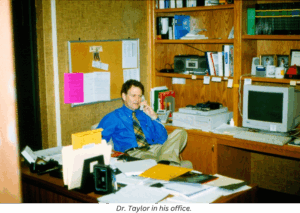
In the early 1990s, and after much deliberation, GGC moved all operations to PCs over Apple computers due to PCs’ data management capabilities. All computers at GGC were AS400s from IBM and were mainly used for Lotus – the first PC spreadsheet application that would eventually be replaced by Excel.
Dr. Taylor was obviously computer savvy, so he also acted as the Center’s IT Director until GGC hired Reggie Gilbert in 2004. When Reggie started, the IT infrastructure advanced but was still modest by today’s standards. For example, GGC had two physical servers and modems for communication, security was minimal, and only the Greenwood campus had network connectivity. Employees also shared computers – the research and diagnostic division had one computer for every 3-4 employees. Now, GGC has multiple servers in a designated room with keypad entry and a cooling system, information is segmented between servers to keep security threats at bay, all satellite clinics and remote employees have network connectivity, and we heavily rely on the internet and email to do our jobs, like submitting claims through insurance portals. And who would have thought back then that soon enough all patient records would be electronic?
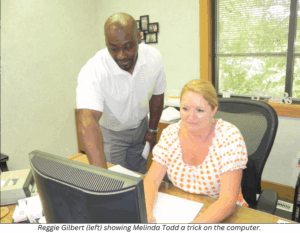 The administration division has come a long way since Boo started in 1991. What began as one person working with insurance, one person doing accounts payable, etc. would evolve into a team of over three dozen professionals. There are now teams for each administrative function who keep GGC going. Think about it – we need human resources to hire clinicians to help patients; IT to ensure the system can handle new equipment like the NovaSeq X Plus that will give patients a diagnosis; accounting to manage grants and pay for equipment; billing to handle insurance claims; and facilities to maintain buildings and facilities so everyone can do their job. While our administrative team doesn’t always get the accolades and gratitude they deserve, GGC simply could not exist without them!
Boo stepped down as GGC’s administrator in 2018, but we couldn’t let her leave us entirely. She now serves the GGC Foundation as the Director of Philanthropic Services. When I asked her what her favorite part about being the administrator was, she said the little things like seeing a plan fall into place, claims getting paid, the fun among the day-to-day grind, and most of all, the friendships.
Post by Caroline Pinson