
Precision Medicine at GGC: Finding Answers for Patients Through the Genomic Discovery Program
GGC’s Precision Medicine Initiative is built upon four interconnected pillars—collectively known as the Four A’s: Access, Analysis, Answers, and Action. Together, these pillars form the foundation of our mission to bring precision medicine to life for every patient we serve.
In this blog series, we’re taking a closer look at GGC’s efforts in each pillar and the vital role GGC is playing in shaping the future of personalized care.
Today, we turn our focus to ANSWERS—the third pillar of our initiative.
At the Greenwood Genetic Center (GGC), the Precision Medicine Initiative is transforming the way we diagnose and treat rare genetic conditions. While technology and testing have advanced rapidly, many patients still leave appointments without a clear diagnosis. That’s where the third pillar of our initiative—ANSWERS—comes in.
The ANSWERS component of GGC’s Precision Medicine Initiative provides clarity, guidance, and hope through the Genomic Discovery Program (GDP).
Challenges for Families Impacted by Rare Genetic Diseases
 Rare diseases are notoriously difficult to diagnose. On average, it takes a patient with a rare disease 5 to 7 years to receive an accurate diagnosis—if they receive one at all. While each rare disease is uncommon on its own, more than 10,000 have been identified, collectively affecting 1 in 10 Americans. Approximately 80% of these diseases are genetic, yet fewer than 5% have an FDA-approved treatment. 1
Families affected by rare genetic conditions face unique and often overwhelming challenges. Many patients experience years of uncertainty as conventional testing fails to provide answers, leaving families with unanswered questions about their loved one’s health and future. The lack of clear diagnoses can also delay access to appropriate medical care, therapies, and educational resources.
Even when a diagnosis is identified, treatment options are often limited or nonexistent, requiring families to navigate complex clinical trials or experimental therapies. The emotional and financial burden can be significant, with parents often acting as advocates, researchers, and caregivers simultaneously.
GGC recognizes these challenges and has designed the Genomic Discovery Program to directly address them—by accelerating diagnoses, identifying personalized treatment options, and providing comprehensive counseling and support to families at every step.
What is the GDP?
 The GDP is a cross-divisional initiative involving clinicians, diagnosticians, and researchers who are working to uncover answers for patients who have no diagnosis or have uncertain results from conventional genetic and genomic testing. Formally established in April of 2024, the GDP provides a structured, research-driven framework to identify accurate diagnoses and potential treatments.
The GDP organizes its work into three tracks:
- Discovery Track: Here, undiagnosed cases are carefully reviewed to determine the most promising approaches and research-based genomic technologies that could reveal a diagnosis. The Discovery team employs several novel genomic technologies, such as long-read sequencing, optical genome mapping, and RNA sequencing available through the ANALYSIS pillar to support these efforts. In addition, the team utilizes comprehensive data analysis (deep phenotyping) and bioinformatics tools to support the diagnostic process.
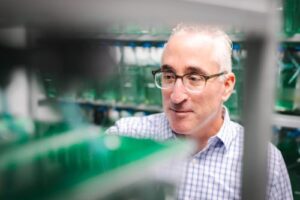
- Resolution Track: Some genetic test results reveal uncertain variants – leaving clinicians and families unsure as to whether the true cause of the condition has been identified or not. Using a variety of experimental methods, and even occasionally, our model organism, the zebrafish, the Resolution track team, led by GGC’s Director of Research, Rich Steet, PhD, develops experiments to determine whether these findings are clinically significant, helping confirm or rule out a diagnosis.
- Treatment Track: Once a diagnosis is confirmed, the members of the Treatment track help patients access existing therapies and clinical trials, as well as consider innovative single-patient treatment options which may include accessible dietary supplements or drugs that are already FDA-approved for other purposes. Led by Dr. Mike Lyons, GGC’s Curry Chair in Translational Genomics and Therapeutics, the Treatment track is focused on improving the quality of life for patients and their families.
Through this collaborative approach, clinicians, laboratory scientists, and research faculty work together to bring answers to patients who have long waited for clarity.
Receiving a diagnosis is only the first step. GGC’s team of clinicians, which includes medical geneticists, physician assistants, nurse practitioners, and genetic counselors, ensures that patients and families understand test results and treatment options. They provide guidance, advocacy, and support to help families navigate complex medical decisions and access appropriate care.
Why the GDP Matters
The Genomic Discovery Program is more than a research initiative—it’s a lifeline for families. By offering novel genomic technologies, advanced bioinformatics, and deep phenotyping, the GDP accelerates the path to diagnosis and personalized treatment.
As Fran Annese, LMSW, GGC’s GDP Coordinator, explains, “We are excited about the productivity through the first year of our GDP, with several families receiving answers after years of uncertainty. These teams have worked tirelessly to improve access to new diagnostic technologies, shorten the time to diagnosis for patients with rare diseases, and identify personalized treatments.”
A Future with Answers
The Answers pillar of GGC’s Precision Medicine Initiative represents the heart of our mission: ensuring that no patient leaves without hope. Through the Genomic Discovery Program GGC is turning uncertainty into clarity and helping families understand, manage, and even treat rare genetic conditions.
At GGC, finding answers is just the beginning of improving lives.
Want to support the GDP at GGC?
Your investment in the Genomic Discovery program helps bring answers and hope to patients with rare diseases. Learn more at ggc.org/foundation.